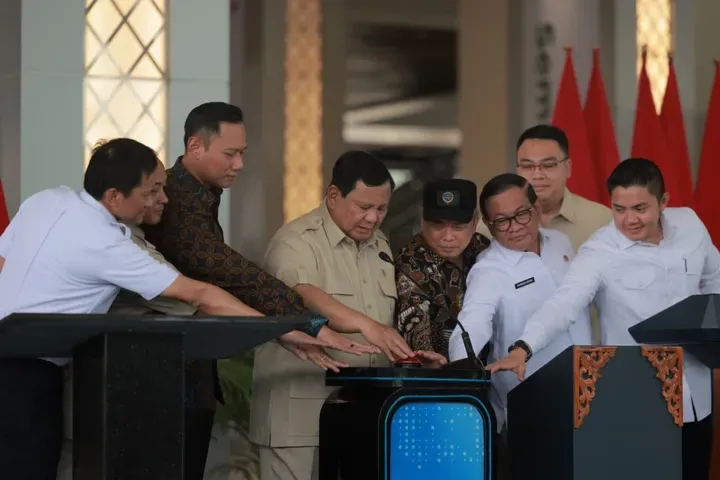
HARIANEXPRESS – President Prabowo Subianto on Thursday, July 30, 2026, issued directives to government officials for the swift advancement of the ambitious Trans-Sumatra Railway and Trans-Kalimantan Railway projects. Speaking at the inauguration of the renovated Tawang Railway Station in Semarang, Central Java province, President Prabowo reiterated his administration’s strong commitment to extending vital rail infrastructure beyond Java. He assigned PT Kereta Api Indonesia (KAI) and the Transportation Ministry with the crucial task of preparing for the construction of these extensive networks, aiming to significantly enhance connectivity and economic inclusion across Indonesia’s major islands.
During his address, President Prabowo outlined a grand vision for national development, emphasizing that major infrastructure projects like these railways are integral to the nation’s future. He challenged leaders to adopt a broad and optimistic perspective in their endeavors. Prabowo specifically called upon PT KAI Director Bobby Rasyidin and Minister of Transportation Dudy Purwagandhi to ensure these projects come to fruition.
Vision for Connectivity Beyond Java
The acceleration of these railway projects is a national priority, designed to reduce logistics costs and significantly improve connectivity throughout Indonesia. Currently, over 70 percent of the country’s rail network is concentrated on Java. In contrast, major islands such as Sumatra and Kalimantan primarily depend on road transport for both passenger and freight movement.
The proposed Trans-Sumatra Railway aims to establish a continuous network by connecting existing rail systems in North Sumatra, West Sumatra, and South Sumatra. This extensive railway is envisioned to link Bakauheni in Lampung province at the southern tip of Sumatra with Aceh province in the north.
Following or even simultaneous with the Sumatra project, the Trans-Kalimantan Railway is expected to play a crucial role in supporting industrial development. This network will facilitate the movement of commodities and strengthen connectivity, especially given that Kalimantan currently lacks an operational public railway network.
Railways as Essential Public Service
President Prabowo underscored that railways should be perceived as an essential public service rather than purely commercial enterprises. He articulated that accessible and affordable rail transport is vital for supporting economic inclusion and enhancing mobility for lower-income communities.
“Railways must serve the people. In many countries, railways are considered a public service — not merely a profit-making business, but one that must operate efficiently. We want railways that help low-income communities and connect smaller cities,” Prabowo stated.
He urged PT KAI and the Transportation Ministry to prepare for the construction of a railway linking the southern and northern ends of Sumatra, followed by a similar network in Kalimantan. President Prabowo also suggested the possibility of building both projects simultaneously.
The President’s directive highlights a strategic shift towards more balanced infrastructure development across the archipelago. This approach aims to leverage rail transport for broader societal benefits, ensuring that even smaller cities and various income groups can benefit from improved transportation options.
Strategic Meetings and Future Plans
President Prabowo’s vision for expanding Indonesia’s railway network was articulated during a pivotal meeting on May 29, 2024. He convened with key officials from PT Kereta Api Indonesia (Persero) and the Ministry of Transportation at the Ministry of Defense office to discuss the accelerated development of national railway infrastructure.
Attendees at this significant discussion included Minister of Transportation Budi Karya Sumadi and President Director of PT KAI, Didiek Hartantyo. Their presence underlined the high-level commitment to these ambitious railway projects.
The meeting served as a platform for President Prabowo to underscore the strategic importance of a robust railway system. He emphasized its critical role in fostering national development and enhancing regional connectivity across the archipelago.
Economic Impact and Connectivity
The expansion of railway networks beyond Java is expected to bring substantial economic benefits. A primary goal is to significantly reduce the nation’s logistics costs, making the movement of goods more efficient and affordable.
President Prabowo highlighted the necessity of connecting various production centers with markets through an integrated railway system. This strategic link aims to boost the competitiveness of Indonesian products both domestically and in international markets.
The proposed Trans-Sumatra Railway and Trans-Kalimantan Railway are poised to become vital arteries for economic growth. They will facilitate the efficient transport of raw materials and finished goods, particularly in resource-rich and industrial areas.
By providing a reliable and cost-effective mode of transport, these railways are expected to stimulate local economies. They will support the growth of industries and agriculture by improving access to supply chains and distribution networks.
Moreover, the focus on Kalimantan’s railway development directly supports the island’s emerging role as an industrial hub. It will ensure that essential commodities can be moved effectively, bolstering the region’s productive capacity.
Railways for Public Welfare
Reiterating his perspective, President Prabowo firmly stated that railways should function primarily as a public service. This ensures that the benefits of improved connectivity are accessible to all citizens, including those in lower-income brackets and remote areas.
He underlined that the goal is not merely profit generation but efficient operation that serves the public good. This approach prioritizes social equity and broad access over purely commercial objectives.
The President-elect’s vision suggests that if necessary, railway services should be subsidized to maintain affordability for the general population. Such measures would prevent high ticket prices from becoming an impediment to essential travel and economic participation.
The directive for PT KAI and the Ministry of Transportation emphasizes the need for thorough preparation and prompt action. They are tasked with laying the groundwork for the construction of these extensive railway networks, starting with Sumatra and then Kalimantan, or even simultaneously.
Ultimately, these initiatives represent a transformative step towards a more integrated and equitably developed Indonesia. The expanded railway system is envisioned to be a cornerstone of sustainable economic growth and enhanced social mobility for decades to come.
This ambitious undertaking underscores the administration’s commitment to robust infrastructure development, aiming to bridge geographical divides and foster inclusive prosperity. The strategic investments in these railway networks are expected to unlock new potentials for regional development and strengthen national cohesion, setting the stage for a more dynamic and connected future for the archipelago.